Lab 04: Gyro Modeling and Control
AE 443 · Experimental Dynamics and Control Laboratory · Spring 2026 · ERAU
Experiment Overview
Gyroscopes are at the heart of inertial navigation systems, spacecraft attitude control, and platform stabilization for cameras, antennas, and weapons systems. A spinning gyroscope resists angular displacement through gyroscopic precession — but without active feedback control, external disturbances cause the deflection angle to wander unpredictably. This lab modeled the open-loop gyroscope dynamics, designed a PI controller to regulate deflection angle, and experimentally demonstrated the dramatic difference between controlled and uncontrolled system behavior when the base is disturbed.
- Derive the closed-loop transfer function for a PI-controlled rotary gyroscope from the open-loop plant model
- Design PI gains to track a 2° deflection reference angle α with specified second-order transient behavior
- Compare the open-loop and closed-loop responses to base rotation disturbances
- Verify system stability for both configurations using the Routh-Hurwitz criterion
Equipment & Tools
- Quanser SRV02 with rotary gyroscope attachment (spinning disk on gimbal)
- Gyroscope angle sensor for deflection angle α measurement
- Servo encoder for base rotation angle θ measurement
- Q2-USB data acquisition board
- VoltPAQ power amplifier
- MATLAB/Simulink with QUARC real-time toolbox
Approach & Controller Design
The open-loop gyroscope plant is a first-order system: α(s)/Vm(s) = (K/Gg) / (τs + 1), where K = 1.53 rad/s/V, τ = 0.9 s, and Gg = 5.20 1/(rad·s). Closing the loop with a PI controller Vm(s) = (kp + ki/s) · e(s) produced a second-order closed-loop transfer function. Matching its denominator coefficients to the standard form gave the PI gain expressions, solved with ζ = 1.05 and ωn = 3.61 rad/s:
kp = Gg(2ζωnτ − 1) / K = 19.79
ki = Ggτωn² / K = 39.86
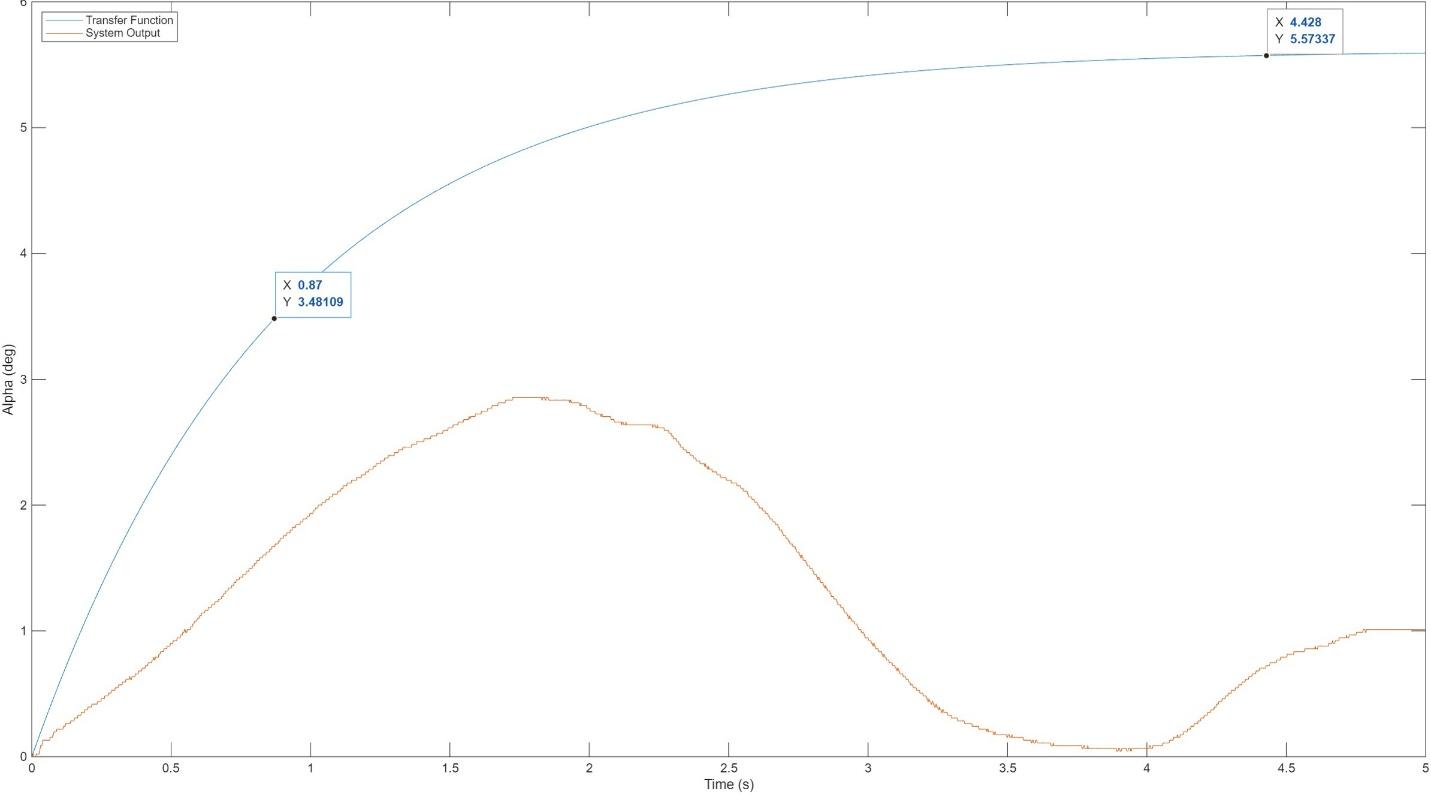
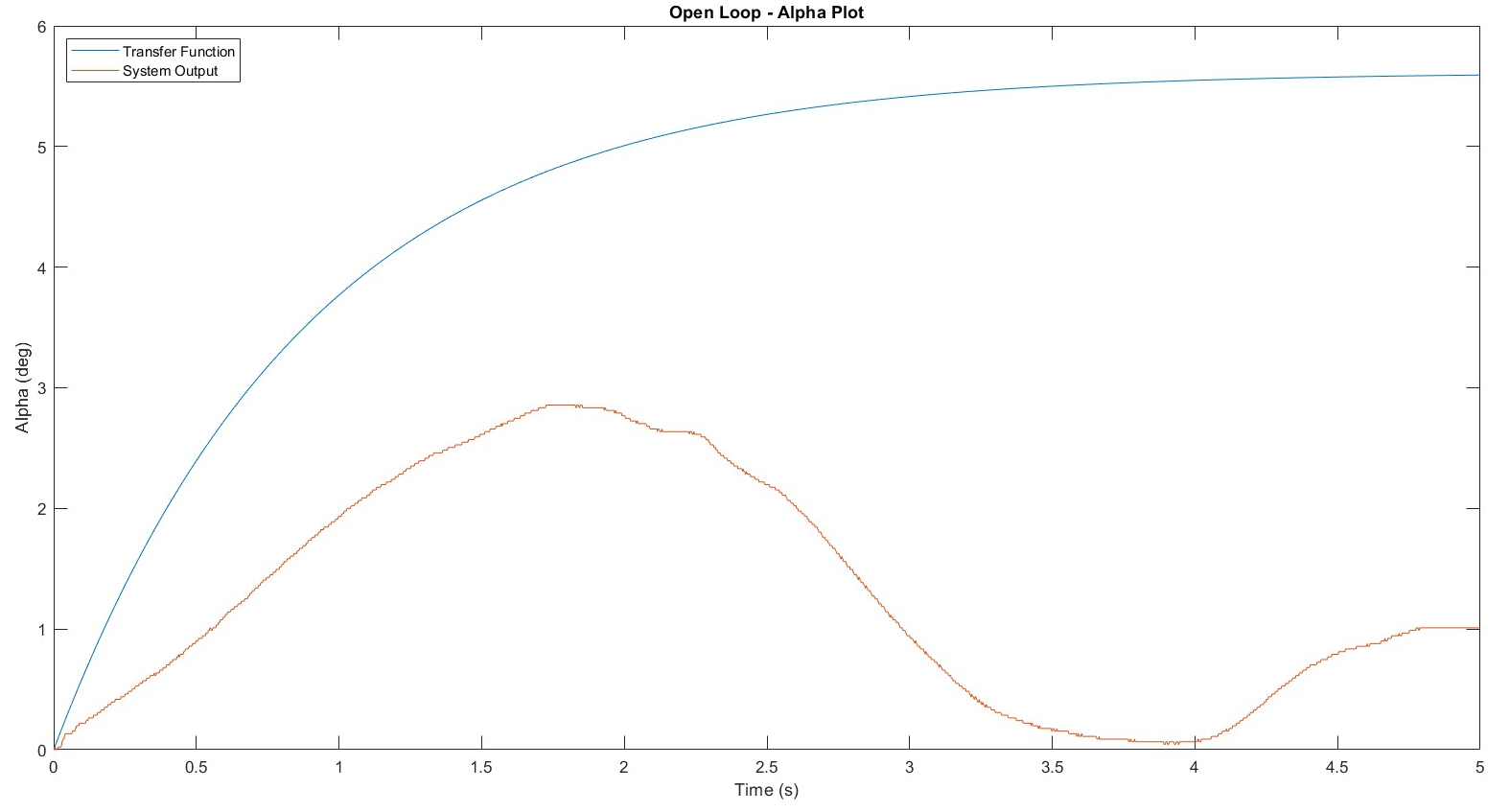
The experimental time constant was identified from the open-loop response: τexp = 0.87 s at the 63.2% crossing, compared to the theoretical 0.9 s — close agreement despite the gyroscope’s more complex dynamics.
Key Results
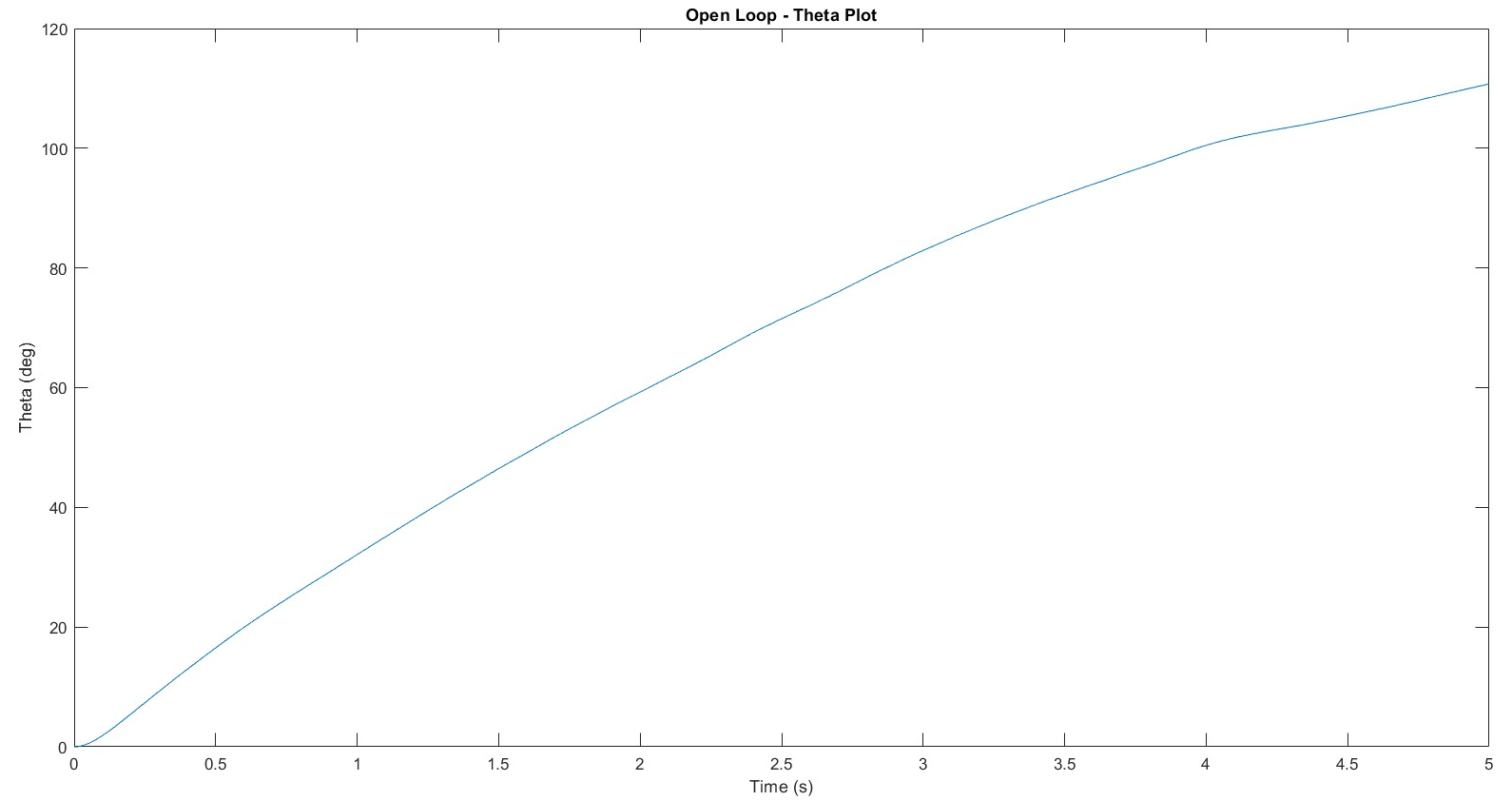
- Open-loop: Theoretical prediction was αss = 8.43°, but measured peak was only 2.8° (66.8% error) — unmodeled gyroscopic coupling, nonlinear friction, and sensor noise caused the real response to oscillate rather than smoothly converge.
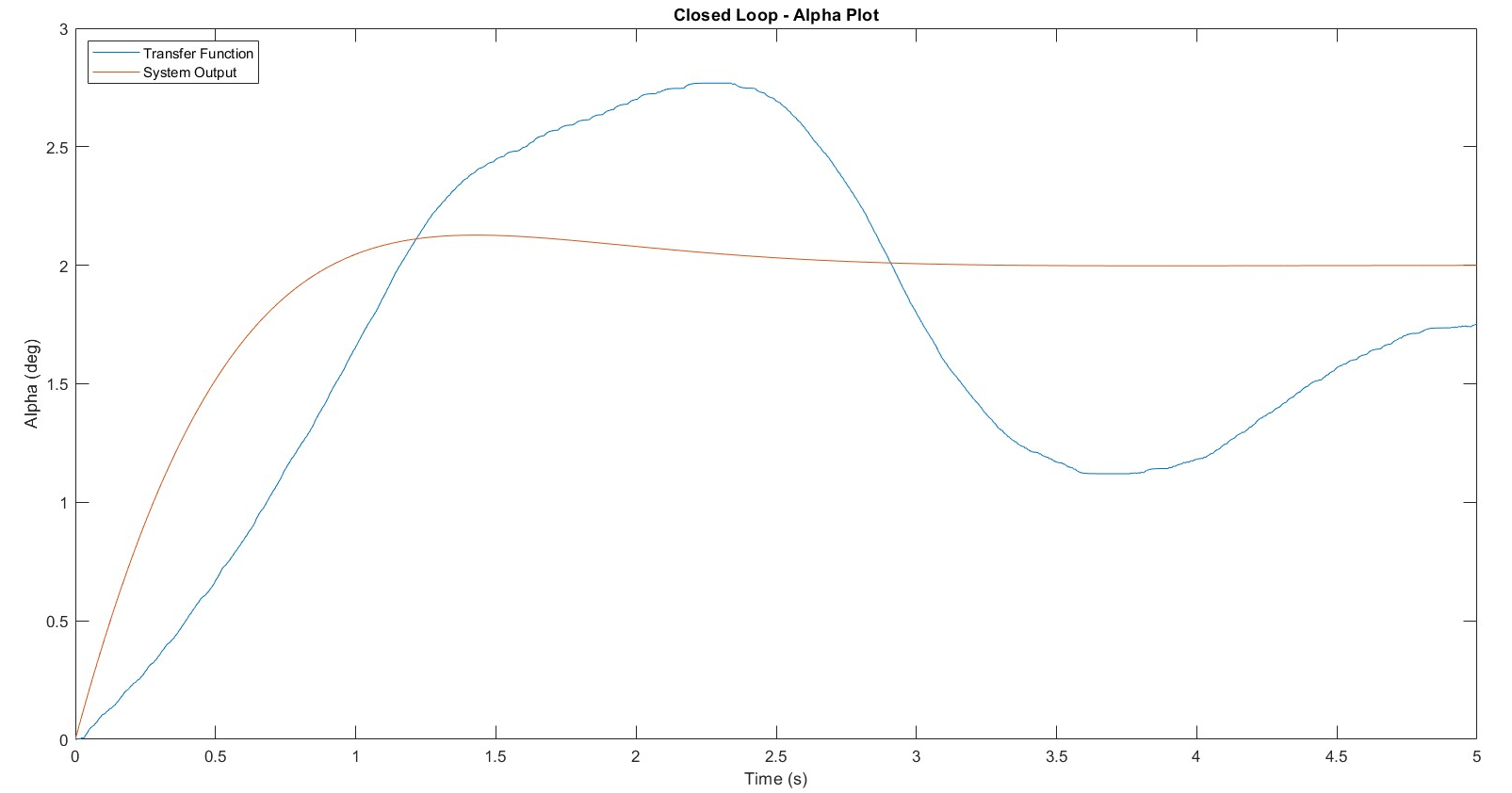
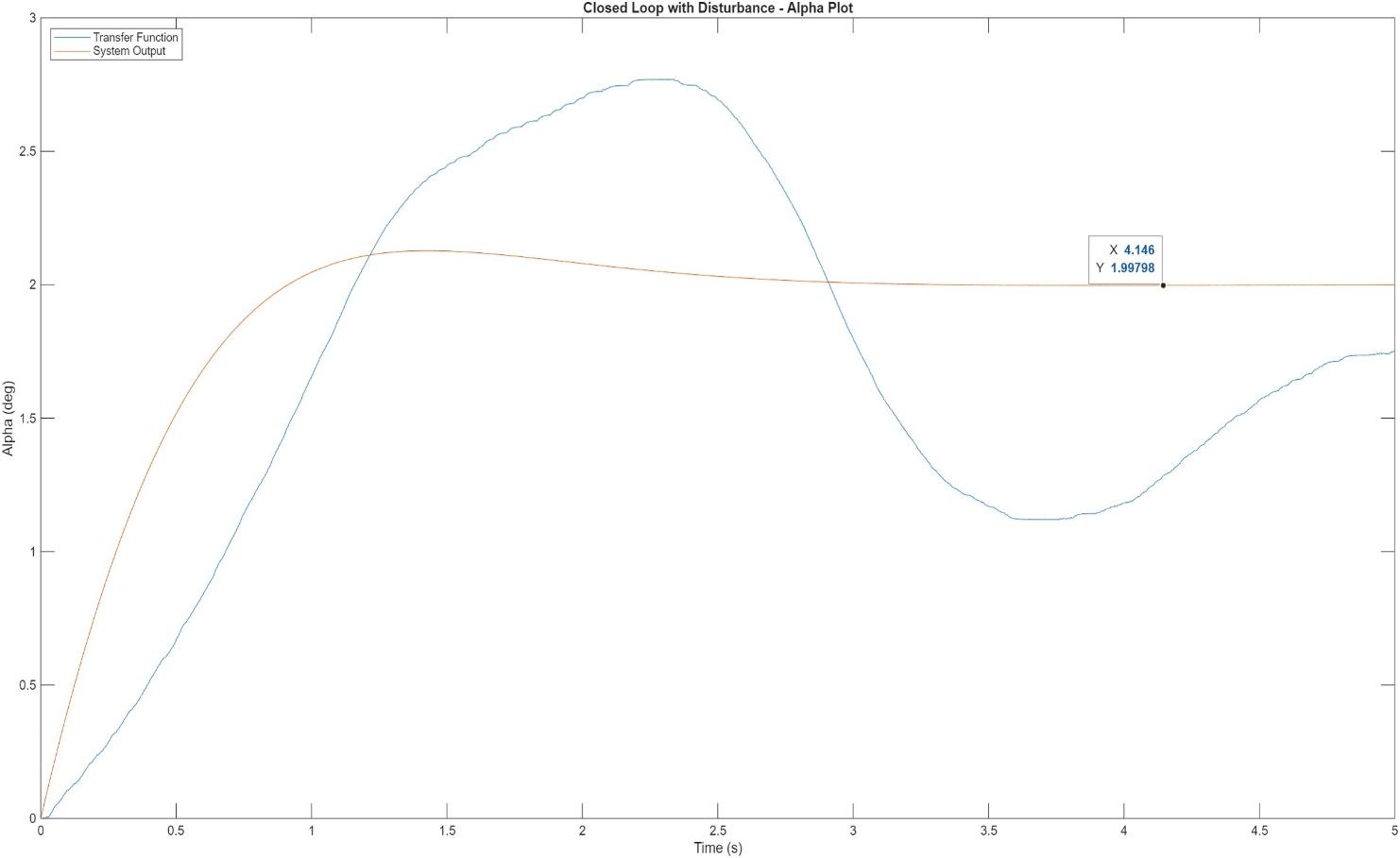
- Closed-loop tracking: With PI control active, α converged to 1.997° (ess = 0.003° ≈ 0), demonstrating that the integral term successfully eliminated steady-state tracking error despite the model inaccuracies.
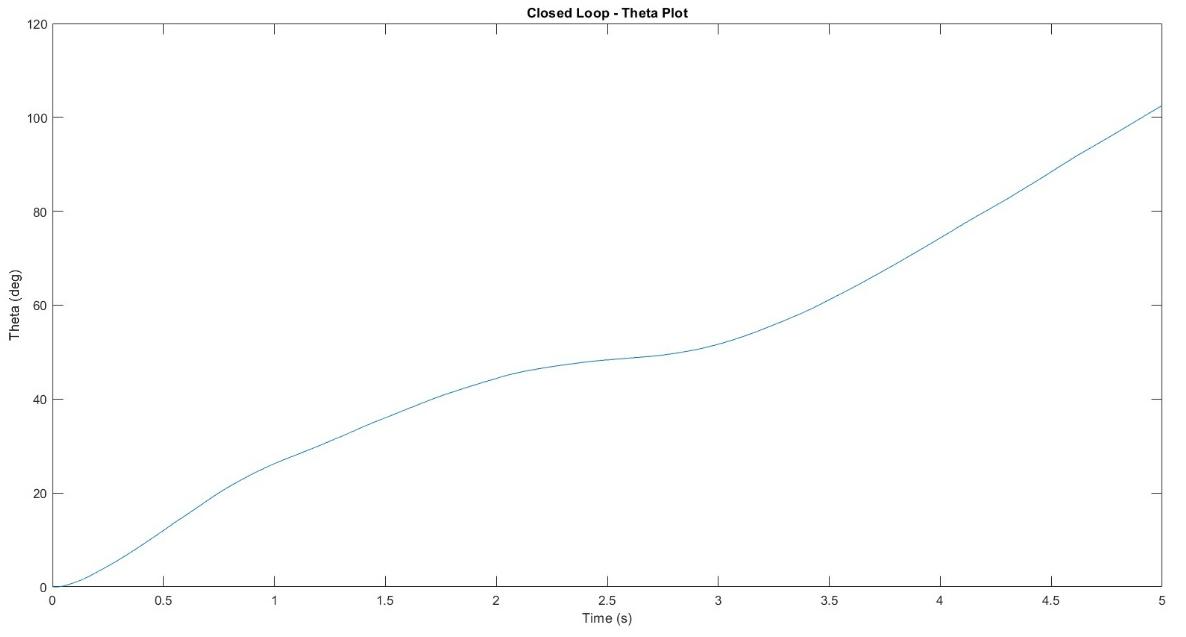
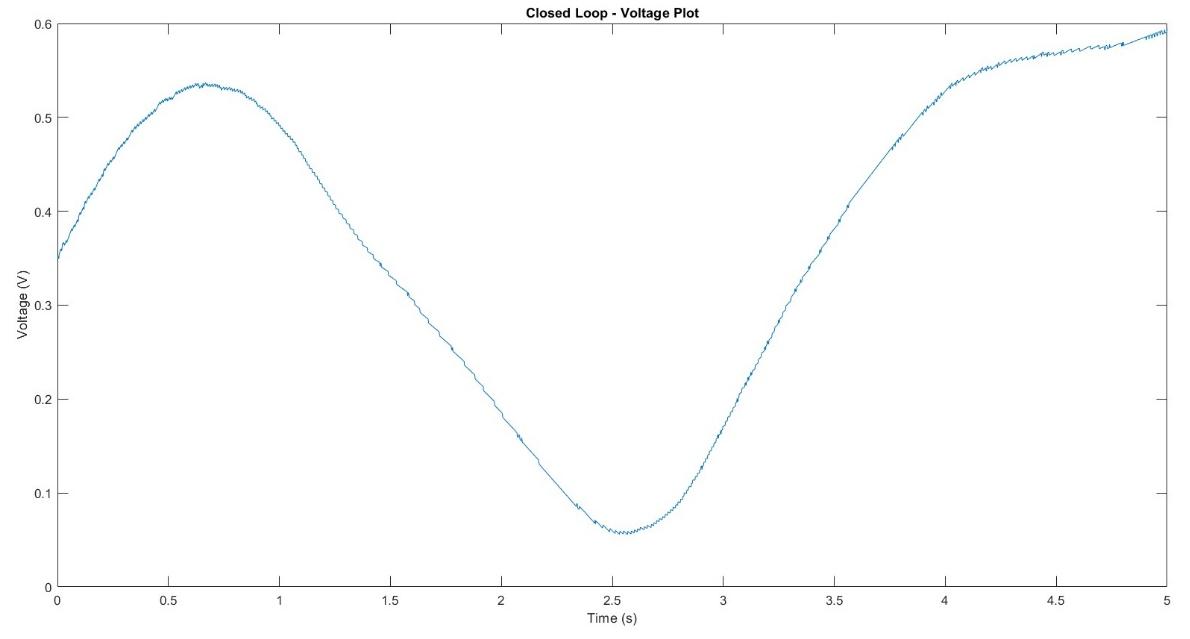
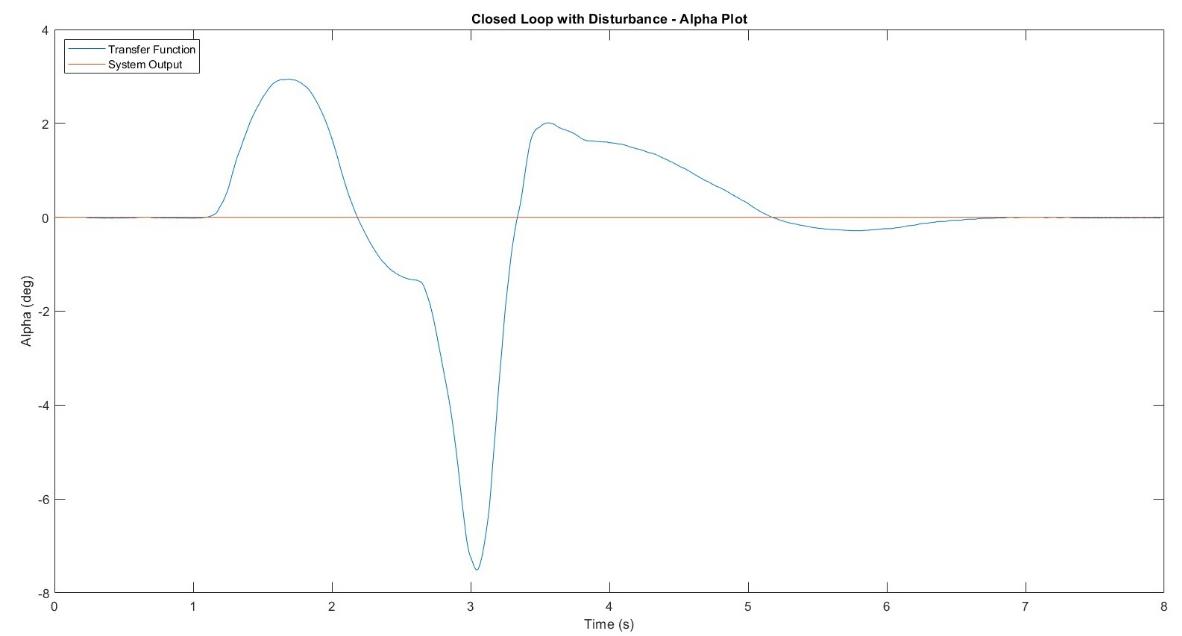
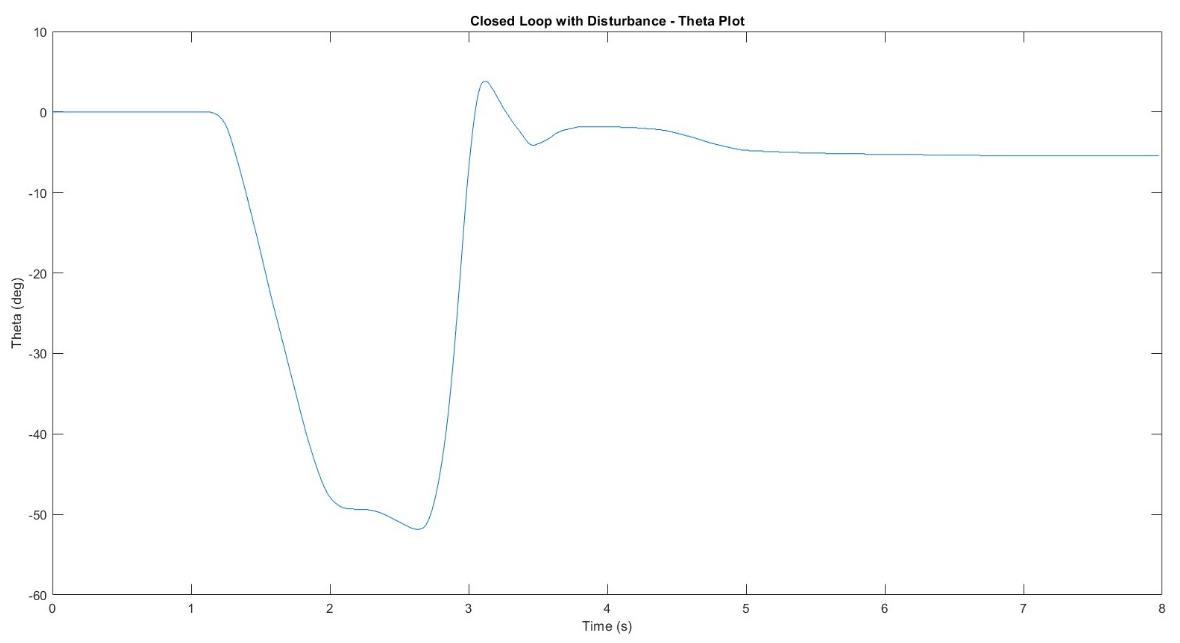
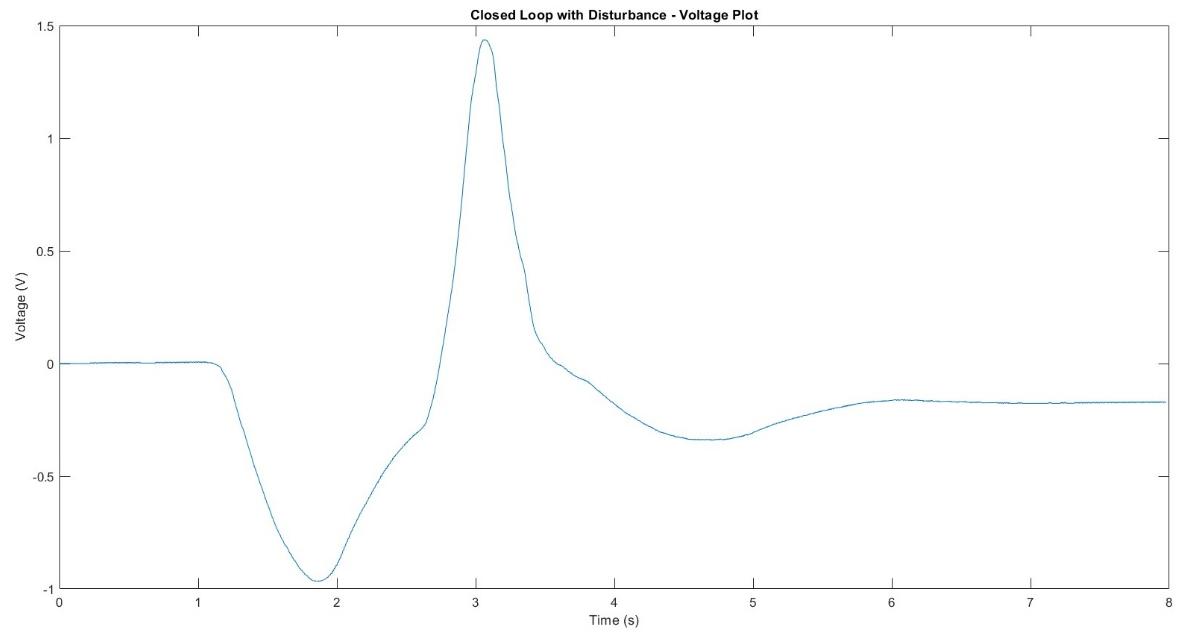
- PI control ON — disturbance: Motor voltage responded dynamically to oppose base rotation; gyroscope deflection held at ~0° (ess = 0°). The base rotated continuously to generate the gyroscopic torque needed to maintain heading.
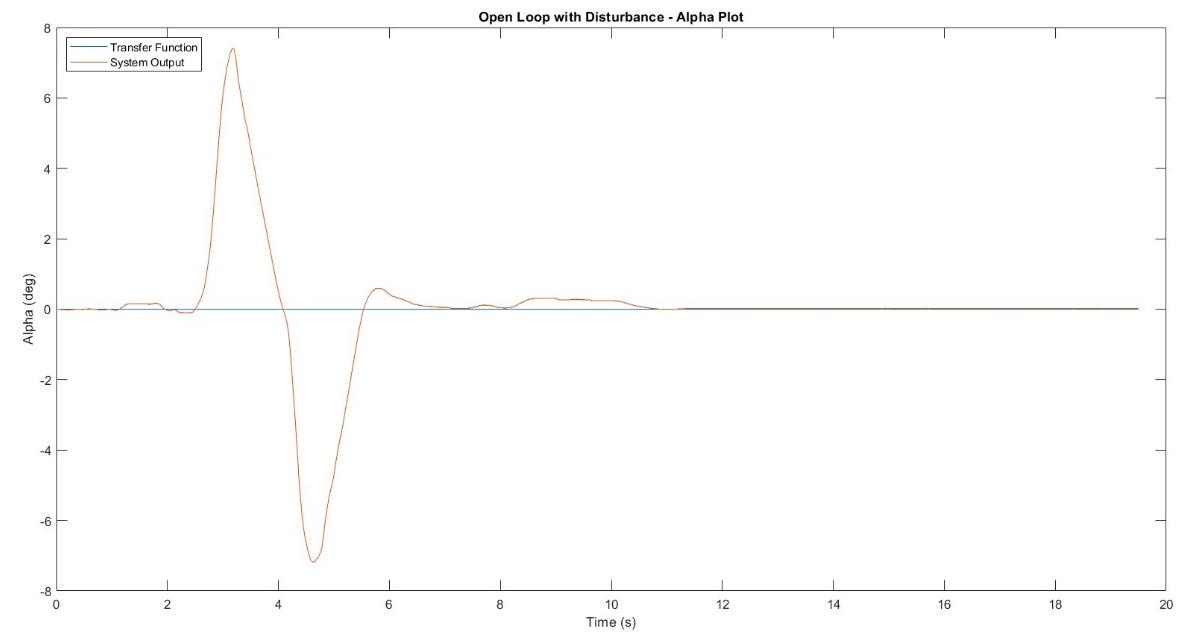
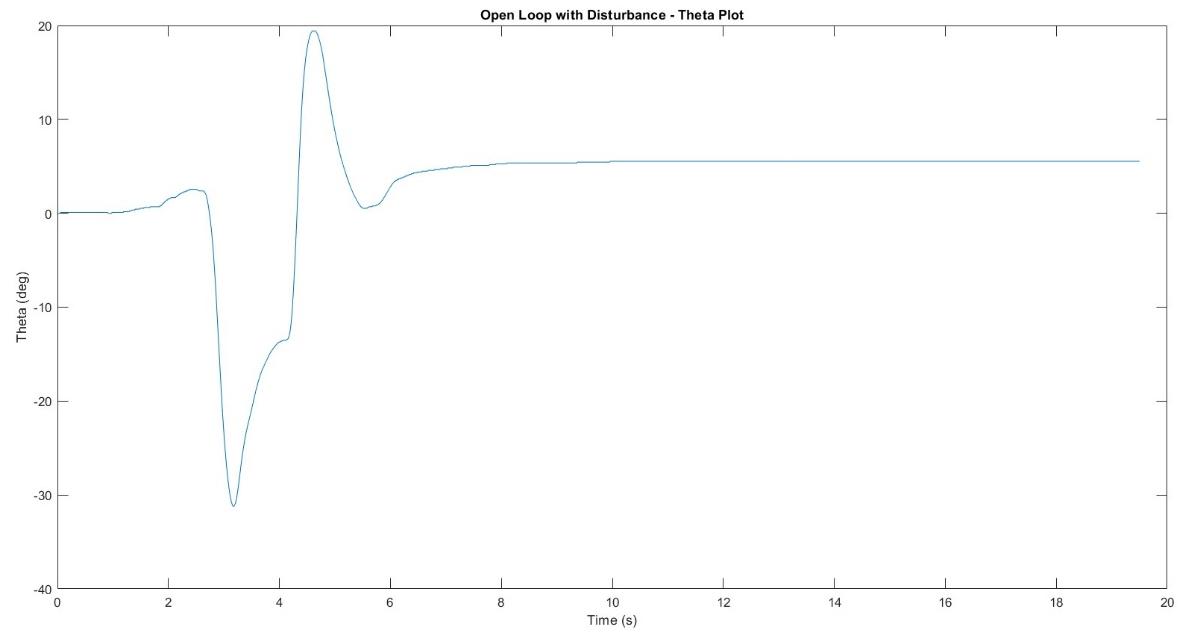
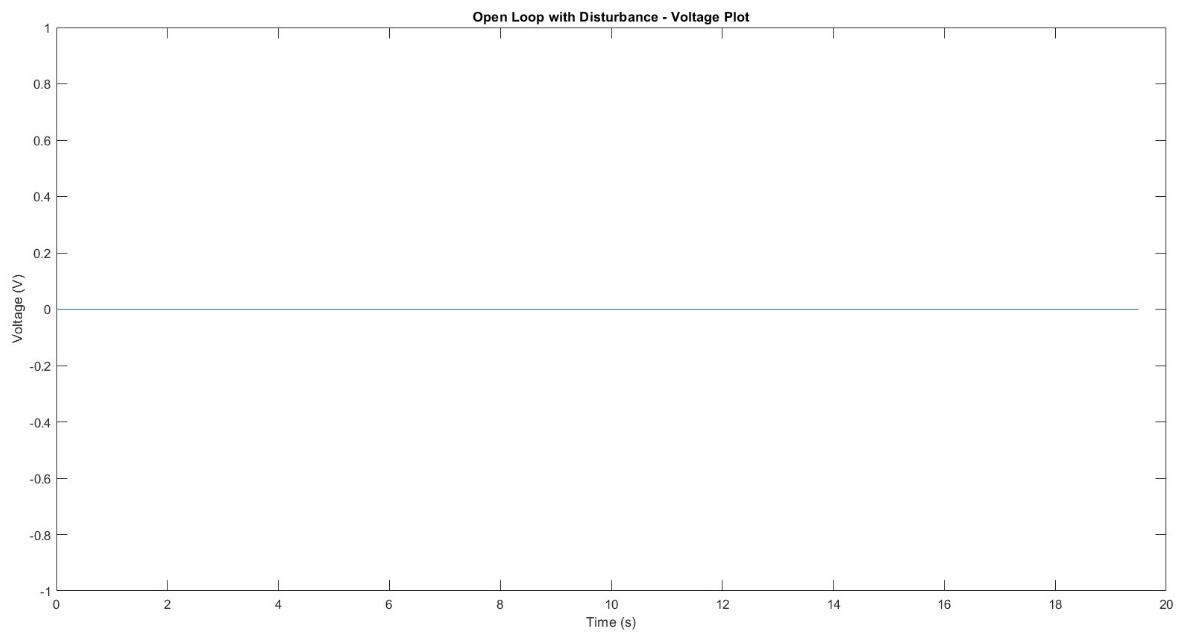
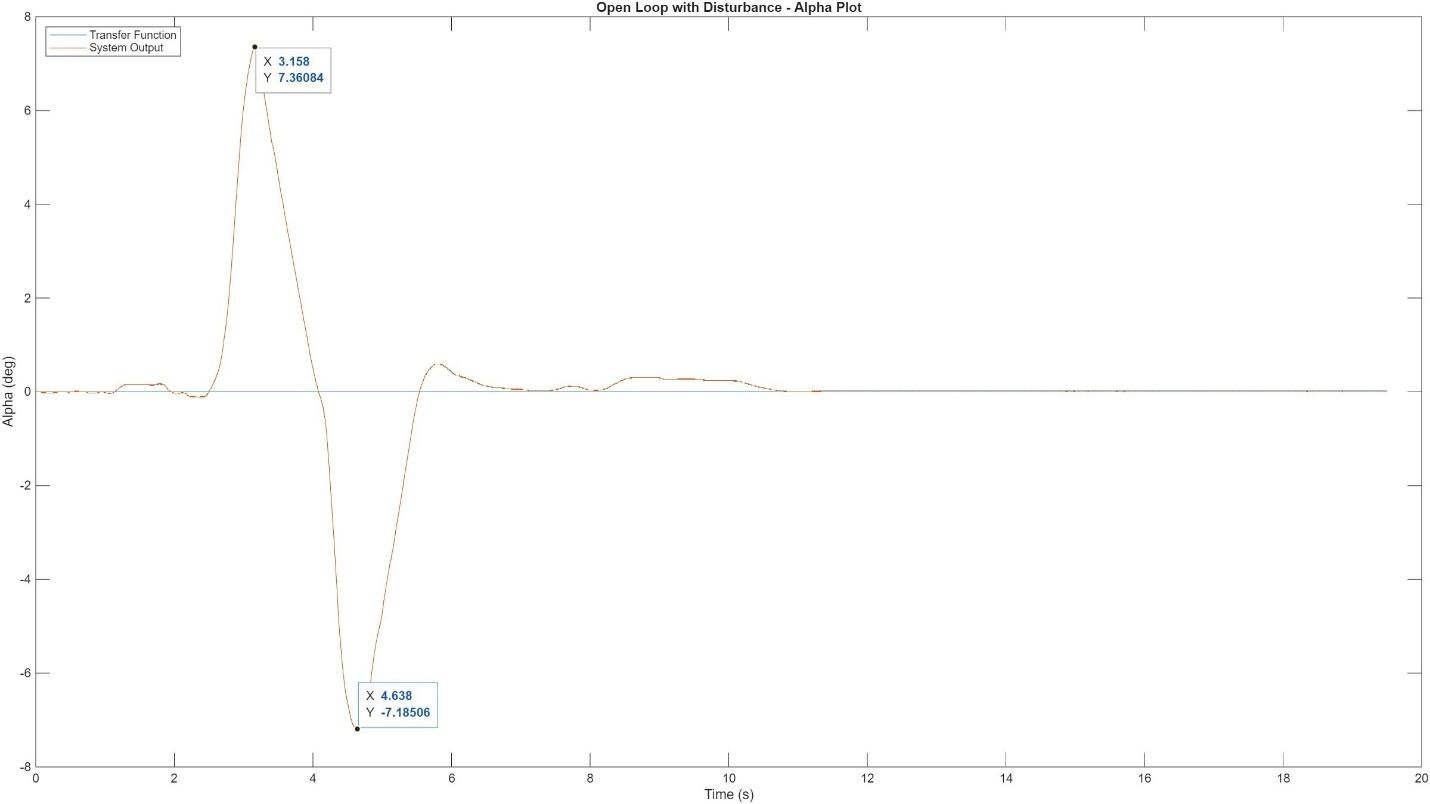
- PI control OFF — disturbance: Deflection reached ±7.4° and took ~20 seconds to passively damp out — the gyroscope had no ability to maintain its heading without active feedback.
- Routh-Hurwitz: Both open-loop (single pole at −1.11) and closed-loop (all Routh table entries positive for kp = 19.79, ki = 39.86) are stable.
Valuable Takeaways
- Passive gyroscopic stability is insufficient for precision heading control. The open-loop disturbance test showed 7.4° of deflection; the closed-loop held near 0°. This is why every real inertial navigation system and spacecraft attitude controller uses active feedback, not just a spinning mass.
- The PI controller converts a passive gyroscope into an actively stabilized platform. This is the operating principle of gimbal stabilizers in camera drones, ship-mounted antennas, and the Hubble Space Telescope’s pointing system.
- Open-loop model accuracy matters less when you have good feedback. The 66.8% discrepancy between the open-loop model and measured response did not prevent the PI controller from achieving near-zero tracking error — demonstrating the robustness that feedback control provides over model-dependent open-loop approaches.
- Gained experience designing PI controllers for a multi-physics system involving gyroscopic precession, applying the Routh-Hurwitz stability criterion analytically, and validating controller performance experimentally under both tracking and disturbance conditions.